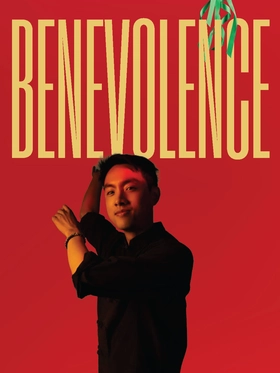
Benevolence
Synopsis
A theater creator’s search for his Hakka roots leads to a multimedia investigation of identity, migration, and the complex history of his Chinese-Canadian family.
Jan 13, 2026, 7:00 PM
Kevin Matthew Wong is of Hakka descent—a Chinese people, he explains, that experienced a long series of displacements over two thousand years and have a unique culture of disparate diasporic influences, from northern China to Jamaica & Vancouver. Benevolence is Kevin’s solo show about what that means to him. He’s contacted out of the blue by Hakka community members at a senior center; they’d like to know if he’d be willing to write & direct them in a show about their shared heritage. Born in Canada with a predominantly Western upbringing, Kevin wonders if he’s up to the task—is he “Hakka enough” to write something true to their experience?
Similar ideas were recently memorably explored as cultural critique in Meet the Cartozians, but the vibe here is personal storytelling more akin to My Son’s a Queer or 300 Paintings, to pick some recent examples. In an 85-minute show with liberal use of video projection, dance elements, and audience interaction (he cut me an apple slice!), Kevin recounts his anxious-but-inquisitive process of researching & developing the show, interviewing his grandmother, visiting temples & cultural centers, dancing, having visions and the like. He’s earnest, energetic, and charming, with a sweaty-from-minute-two youthful spryness and a steel trap full of pop culture references.
There are protracted sequences when Kevin does impressions of his quirky new acquaintances with the rapid-fire patter of a stand-up comedian—one that I wished had a warm-up act. Tough audience, you know. Kevin’s anticipated this and tries to work the crowd up a little bit at the top with some participatory pot-banging, but, even so, the plain fact is that a lot of the humor didn’t land, to an extent that he nervously ad-libbed about the lack of response a couple times. And it hurts the storytelling more than you might expect, too. I gathered that the impressions, generally good-hearted, were meant to honor the folks who made Kevin feel welcome; after all, they represent the contemporary culture as much as anyone does, right? But if this part of the show isn’t playing, it deflects some of the thrust of “What does it mean to be Hakka?” into ambling genealogical education—an extended school project with sections like “And then I met this man and talked to him for awhile.”
Setting aside the narrative, though, it’s really clear that Kevin has a gift for visual storytelling. He does some things here that seem effortless but definitely are not. He periodically & precisely rearranges a pair of folding tables and a draped cloth as projection surfaces, sometimes overlapping each other, with interesting layers of color, light, & shadow in each configuration. His movements and dances are tightly choreographed in sync with video. Props—big ones, sometimes—come from unexpected places. I only wished there was more of this.
Despite the lulls, I thought it was a worthwhile viewing. Tough to get tickets; the show’s in a tiny teaching studio on the 7th floor of a less-traveled building at Lincoln Center and seats were offered on a pay-what-you-wish basis, so they disappeared pretty quickly. I was able to get one on Theatr for $6.