Meet the Cartozians
Synopsis
Follows two sets of Armenian Americans; one man fights for legal recognition in the 1920s, and a century later, his descendant fights for followers and a competent glam team.
Dec 6, 2025, 2:00 PM
Talene Monahon has a lot of questions—questions about who gets to define race & how, the necessity of “passing” to sell a narrative, what it means to be “from” a place, whether it matters when geopolitical borders are redrawn, how it affects an inner sense of identity to immigrate, who decides who gets to occupy a place & why, and—Meet the Cartozians is her new play that, at two hours fifty minutes, still feels like it’s bursting at the seams. It’s hard to blame her for going a little long with it; these kinds of conversations tend to sprawl. Beyond their inherent complexity, there’s special potential to offend when you discount someone’s lived experience—in 2025, considerate folks like Monahon have learned they ought to hedge their opinions, anticipate all the counter arguments, hem and haw.
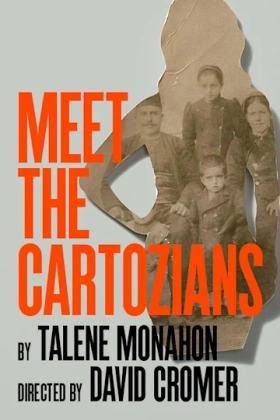
She takes us back about a hundred years in Act 1. The Cartozians are Armenian immigrants about to go to court to try to assert that they are white Christians, good Americans who ought to be admitted as citizens. A hundred years later, Act 2 introduces their descendant, a rip on the Kardashian clan, who wants to film an episode of TV in which she gets in touch with her Armenian roots. The irony is that grandparents and grandchildren are working towards opposite goals, and we are meant to ponder what exactly it means to be American, or to be a member of a race, or to claim whichever culture that your family claims, based on where people lived at some unspecified time in the near past.
I really liked the first act, but was a little less certain about the second, which felt a bit more like a blunt weapon. A significant portion of the second act is a group of sociocultural fluents of Armenian background having an argument about their heritage, investigating it from every angle, ironically demonstrating the same human flaw as our forebears’ immigration forms—a desire to construct an absurd taxonomy of human narrative. Monahon satirizes these kinds of conversations in the same breath that she substantially engages with them. No matter how airtight you try to make your theory of humanity, she suggests, there are always imprecisions, edge cases, and exceptions.
It basically works—it’s well-written, entertaining, tightly integrates form and function—but, man, three hours of dense cultural criticism can wear you down a little bit. It begins to feel a little didactic, especially towards the end; characters feel more like mouthpieces than characters. (See also Art on Broadway.) Meet the Cartozians certainly doesn’t collapse under the weight of its ambition, but the girders are groaning.