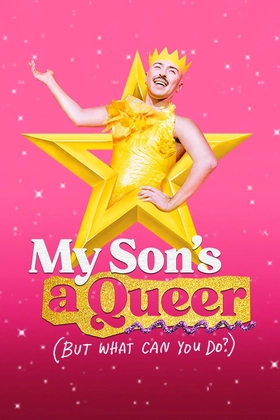
My Son's a Queer (But What Can You Do?)
Synopsis
Performer Rob Madge uses their own home video archives to chronicle a childhood attempt to stage a Disney parade in their living room.
Jun 13, 2025, 8:00 PM
There’s a recurring detail in this show that I really loved - as Rob is showing you old home videos, they look away from the screen and speak & move in perfect unison with their younger self. It might not seem that important to everyone, but I think it powerfully attests to the authenticity of their message.
I’d like to cite a long list of reasons why I don’t like to mention that I’m trans in my little reviews-that-nobody-reads: personal safety, fear of having my point of view pigeonholed as a queer person, a belief that good theater should be able to speak to universal human experience, and an escapist preference for shows about subject matter that I know less intimately (and am less tempted to scrutinize). These things are all true to different degrees, but any honest accounting of why I avoid explicitly addressing my transness in any context has to have shame at the top of the list.
I had a decidedly different experience from Rob. I grew up in environments that were not very receptive to gender nonconformity and I was very good at masking mine. It surprised everybody when I came out at 25 even though I had known in my heart that I wanted it for a decade-plus. I don’t have a single photo of me in a dress before then; not because I didn’t take any, but because I would immediately delete them for fear of being found out. In the present day, I don’t have any old photos of a person that I feel I actually am, and yet the more recent ones still don’t represent the person that I feel I ought to be.
I offer the extended personal reflection as counterpoint: to say, with credibility, that a central plank of my queer experience has been wishing I was somebody else. When I see Rob on that stage speaking along with their younger self, I see a person who is authentically embracing the continuity of their queer identity - “this was me, and I’m still me, and I’ll always be me, and you can take it or leave it because I’m going to thrive either way.” It’s just so hard to have that healthy of a perspective unless you, like Rob, grew up with people nurturing that side of you. That’s the point. It costs very little to allow kids to be themselves, and it makes a huge positive difference in their lives if you do.
Okay, here goes. The double-edge of the thing is that it doesn’t resonate perfectly as a piece of theater for me. It certainly tugs at the heartstrings - I felt good walking out of the theater, but less so when I started to think about it. I think it’s a little bit, err, faux-inspirational qua self-indulgent. (I know. Sorry.) It’s not actually that controversial to say that supporting your kids is good for them, right? The problem is that parents are flawed people with their own biases and lived experiences that influence their ability and willingness to support their kids on one dimension versus another. We have differing, not altogether fixed ideas of what exactly constitutes “support.”
Put another way, I think there’s an ungenerous-but-not-outrageous interpretation of Rob’s parental hagiography that “my parents are good because I’m confident in my queerness, and yours are bad if you are not.” And I just think that life demands more nuance and grace than that. I have wonderful parents who supported me in many other ways and have done their genuine best to embrace something that they weren’t initially comfortable with because they love me. Sometimes they fell short of where I wanted them to be, but on balance, I feel like I was dealt a pretty good hand.
Hoisting that into the context of universal human experience, nobody gets spared by the parenting machine. If you don’t have one problem, then you have another. I am very happy for Rob (and jealous of them) that they can embrace their queer identity so proudly and centrally, but ultimately my response to the show was tempered a little bit by my very different road to self-acceptance. (Not that I expect a comprehensive manifesto; I just can’t help but price in my life experiences when I react to a piece of art.)
For me, the path to peace started with not pigeonholing myself - being queer doesn’t necessarily mean that I have to frame everything in my life as being about queer personhood and the disadvantages thereof. Let it be your adjective, rather than your noun. (“Queer” and “a queer” have very different implications, and I wouldn’t like to reduce myself to the latter, as Rob is doing.) Identity is richer than that, and there are so many other things about me and the world with the potential to spark joy. I’ve done enough perseverating over the circumstances of my childhood. I’ll be over here counting my blessings.