Just in Time
Circle in the Square Theatre
New York, NY
New York, NY
What I'm seeing lately!
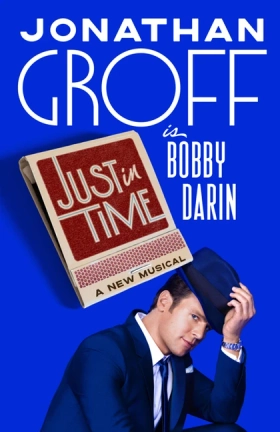

Entertainer Bobby Darin grows up from a sickly child in the Bronx to a multi-genre superstar, fueled by a prediction that he wouldn’t live past age 15.
Of all the ostensibly dramatic works I’ve seen on stage, the quality of the material probably matters the least here. The creators clearly worked backwards from the idea that Jonathan Groff should sing a Bobby Darin concert on Broadway, and they’ve managed to reverse-engineer just about the loosest possible approximation of a biomusical around him. Even for the genre, this is pretty light fare.
That’s not to drag it, because it’s basically entirely successful in execution. The lucky thing for all of us is that Jonathan is the type of performer that can get away with something like this, and he blows the doors off the building playing himself sort-of-playing Bobby. He’s every bit as damp as advertised, oozing charisma and other fluids all over the stage for practically the entire runtime.
The rest of the company admirably fills in the gaps. The three sirens especially are performing some serious feats of cardiovascular endurance both on- and off-stage. The venue is perfectly intimate. The stage looks gorgeous. If you allow yourself to have a good time, you almost definitely will.
“My name’s Jeremy,” he drawls, and the experiment begins. Since I stopped by Just in Time in previews a year ago, original star Jonathan Groff “completed his ascendance to full musical stardom,” selling out the Circle in the Square for a full year on the dime of a legion of dedicated “Groffies.” A new “Original Concept by” co-credit tips the fedora at what seemed apparent from the start: this sample spritz of a biomusical was written to substantiate his doing a big-budget Bobby Darin cabaret on Broadway. It isn’t an especially controversial opinion to suggest that Jonathan’s charisma was buoying perfunctory material, but it necessarily begs the question whether the show can survive and thrive with a replacement lead.
In Jeremy Jordan, the producers think they’ve got their guy. The theory of the case seems sound: a bona fide leading man in demand, Jeremy arrives hot on the heels of star turns in Floyd Collins and a return engagement in The Great Gatsby. Indeed, this is the basis of his introductory monologue, told out of character, like Jonathan, to establish, like Jonathan, that he’s a fiend for live performance, like Jonathan. I’m giving away where I’m going, but before I get there, let me say that I can’t identify any particular technical deficiency with Jeremy’s performance, and I expect that anyone late to the party will find his Just in Time fun and satisfying. He nails all of Bobby’s songs, his eyes well up in all the right moments, and he goes gung ho on the choreography, flanked by the tireless sirens. (Shoutout to Julia Grondin, almost at 450 performances, which feels like a crazy feat—I think every moment those girls aren’t spinning or high-kicking must be spent in wardrobe change or sprinting to another stage entrance in heels.)
In the not-so-distant past, I’ve harped on how certain kinds of shows are better suited to replacement casting than others. For traditional plays and musicals, the right recast can unlock the depths of the material (Chicago) or otherwise offer an interesting alternate interpretation (Gypsy). On the other hand, recasts can face a lot of headwind when the show’s genre trappings are at odds with the freeze-after-opening Broadway model (Hamilton) or when the show is too dependent on a central performer (Good Night, Oscar, Queen of Versailles). I think Just in Time trips on both of these hurdles. The thing about good cabaret—late-nights-in-subterranean-rooms-nursing-your-two-mandatory-martinis-knocking-knees-under-a-flimsy-little-bistro-table cabaret—is that it absolutely must cultivate a sense of intimacy, be it through eye contact or proximity or personal storytelling. More than a revue, there needs to be a reason to sing these songs in this sequence to this audience.
What made Jonathan-era Just in Time remarkable was how it was able to cultivate a supersized approximation of this. Not only is the set designed like an art deco nightclub (little tables and all) in the basement-level Circle in the Square, but the creative team was able to construct a parasocial mystique around the talents of its lead performer. It was his passion project, and he was taking a risk bringing it to Broadway without a tryout. The central relationship of the show was Jonathan identifying with Bobby Darin’s compulsion to exist in time and place with a live audience. The tickets were expensive. If you sat close enough, the wine was free and Jonathan would lock eyes with you, brush against you, soak you with spit, and maybe even ask you to dance. Just in Time wasn’t written like a true biomusical because it didn’t purport to be one.
There was always a certain practical inauthenticity to the affair. The wine is served in plastic coupes and seized before showtime, the tables are bolted to the floor, and 776 seats are too many for genuine intimacy. But Jonathan’s magnetism made up a lot of the gap, and as great as Jeremy is, and as much as he might very well identify with the same compulsion, he can’t replicate the feeling because the show doesn’t belong to him. The idea that you can plug someone else into Jonathan’s cabaret act and just change a couple of introductory lines is spell-breakingly mercenary—it undercuts both versions of the show to reveal that this is, in fact, just a book musical, and not an especially interesting one. It still looks good and sounds good and that’ll keep it alive for a while, but it’s the beginning of the end. I sat table-level and the other seat was empty.