The Maids
St. Ann's Warehouse
New York, NY
New York, NY
What I'm seeing lately!
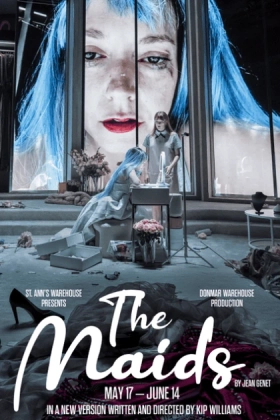
While their wealthy socialite mistress is out of the house, two unstable housemaid sisters indulge in a sadomasochistic ritual of role-playing her murder.
This is a funny way to describe a Kip Williams show, but I was surprised by how much restraint he exercises here, at least compared to his other recent work. Dorian Gray and Dracula were fundamentally cut from the same cloth: novels adapted to stage in service of an overwhelming, video-forward directorial conceit that occasionally obfuscated the text, anchored by the solo performance of a star with crossover appeal. Although The Maids continues the streak of camera gimmickry and even overhauls the text, it’s a surprisingly conventional revival—Williams applies his hypermodern sensibilities to expand an existing work instead of dismantling one to build his own metaphor. (He’s even got a pretty great traditional set!)
Jean Genet’s 1947 three-hander sees two sister servants ritualistically role-playing as their abusive mistress, taking turns acting out a power fantasy and plotting, with unclear earnestness, how they might bring about her demise. Dramaturgically, the maids have no reason to exist except to serve the matriarch; they’re obsessives, unable to separate their loathing for and desire to be her, and their murderous schemes can’t ever succeed. Where would they go? Who would they be? Firmly a part of the Beckett-adjacent midcentury absurdist tradition, The Maids is rich in themes but light on background details, offering directors a lot of leeway for interpretive spin. Without a doubt, the piece is situated at the intersection of power dynamics and desire suggested by role-playing, but the extent to which this evokes class conflict, the psychology of servitude, eroticism, or outright psychosis varies between productions. A not-insignificant camp of Genet purists insists (and not without basis, although the production history doesn’t bear it out) that this is a queer play that demands an all-male cast. There are a lot of ways to approach it.
A good recent comparison for Williams’s direction is Jamie Lloyd’s 2025 production of Waiting for Godot, which imported an existing (and very silly) pop culture duo as a contemporary bridge to an opaque arch-play. Whether this approach makes the work more accessible or just puts it in front of an unreceptive audience, I’m not sure; Godot, I recall, also elicited some confused reactions. Williams goes even further, updating The Maids with a punchy new adaptation (it’s literally so iconic) that casts the mistress as a social media influencer—famous because she’s famous, wealthy because she’s wealthy, and beautiful because she’s beautiful. This arbitrariness maps really tidily onto the structure of the original play; even for the prettiest among us, the recipe for social media virality is far more random and impersonal than we’d like to believe. The maids can’t be the mistress because the algorithm says they aren’t.
Williams’s central insight is that the personal curatorial effort of social media is its own form of role-playing. Unlike his earlier shows which kept the camera on for the whole runtime, The Maids uses them somewhat sparingly, only in moments when the characters are inhabiting their fantasy personas, which are, of course, mimicking each other. The video feed is displayed over the mirrors, blocking out the characters’ ability to see their real selves. When the maids perform their ritual, the mistress impersonator is very clearly being influenced, wearing Madame’s clothes and makeup and wig. What they desire is to be the object of desire. Of course, it isn’t possible for everyone—there is no desire without scarcity, and the influencer cannot exist without people to influence. There cannot be a mistress without her maids, but the maids likewise need their mistress. She’s pretty hard to kill.
To a significant extent, it feels like Williams is going back to the well. Dorian Gray traded heavily in themes of the homogenizing effect of social media. But The Maids offers a more sophisticated iteration of the thought: a grimmer postulation that many of us get something useful out of influencer culture, and, indeed, would be perfectly happy to keep it if only we were one of the chosen few. It doesn’t matter if there’s no realistic path to get there, because as much as anything, the fantasy is itself the influence. It’s all too easy to imagine that if you look the right way, strike the right pose, and film the right video, that millions of followers could hang on your every word, too. Many people rearrange their lives to chase that feeling. Or maybe you profess to hate it, or insist that you’re totally indifferent—but I bet you’re still ritualistically logging in at night more than you care to admit.