The Lost Boys
Palace Theatre
New York, NY
New York, NY
What I'm seeing lately!
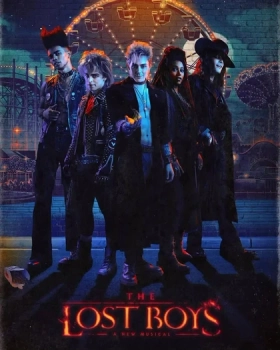
When a mother and her two teenage sons move to town in desperate need of a fresh start, they soon uncover the darker side of the boardwalk: their new friends are a gang of dangerous teenage vampires.
A lightweight popcorn-muncher of a vampire rock musical in which the major achievement, for sure, is the scenic and lighting design. The backdrop, implacably true to an ‘80s flick, is this angled cross section of a three-tiered industrial space—a warehouse, a sewer, or an underground lair, perhaps, lined with metal walkways and stone archways which alternately serve as actor entrances and light spills. These are used for really nice, varied purposes throughout the show: cool, white moonlight beams in from different angles, colored carnival lights form the entrance to a fun house, an elevator shaft lifts the cast on one side, and guitarists suddenly appear bathed in red, as if plucked straight out of a music video. Other scenes cast light from the same arches on detailed foreground sets to beautiful effect. One lovely sequence sees two characters sit on the ledge of a billboard looking out at a sunset; as their spotlights shift to cooler tone, the backdrop is a blocky color gradient, transitioning from dusky-grey-to-royal-blue to midnight-blue-to-black, with pinprick stars twinkling into view.
All that, and generous helpings of aerial choreography, neon signs, flashes, booms, pops, et al—it’s all so spectacular that you’ll be inclined to overlook an unambitious book. And, after all, why shouldn’t you? LJ Benet, Benjamin Pajak, and Shoshana Bean comprise a central family unit of discrete Plots A, B, and C, which range from “going through the motions” to “mostly a diversion.” Shoshana is most shortchanged by this, which is a bummer for such a captivating performer, but her four-ish songs (of which she gets to belt on about three) all feel among the least essential of the bunch—especially “Be Kind, Rewind,” which sees her levying fees on ne’er-do-well teens as an employee at a video store. (You can’t cut it outright, either—your second-billed star with the rocket ship voice probably needs to have at least one feature in the first act, right?)
That’s far from the only lyrically lightweight song, which I don’t know that I would ascribe to quote-unquote “bad writing” as much as a consequence of the decision to adapt this particular story as a rock musical. As suitable as that feels for an adaptation of The Lost Boys, it’s a complex task, with story and character beats gated behind mechanical explanations of what exactly is a “half-vampire” as opposed to a “full vampire,” the steps to become one and then the other, how to escape your fate, and how to kill. It’s not very rock-‘n’-roll to sing about which Vampire Tropes are Actually Common Misconceptions in this universe, so they don’t. Indeed, it feels like the score is at its best and most personable when it veers into blow-your-ears-out rock, conveying little information at all. (Maybe this is the comfort zone for the composers, a real-life rock group?) After a thrilling first act, the second feels like a comedown, jammed up with the responsibility of expository book scenes so that the plot can unspool.
Nevertheless, it is a fun time, particularly when Ali Louis Bourzgui swaggers around the stage (and the air) as David, the frontman of the four-piece vampire band. Not only does he have the most authentic-sounding rock voice among the principals, but he speaks in this droll baritone that’s like a cartoon vampire inflected with menace and maybe even a whiff of homoeroticism. I think the underlying material has some weaknesses, but when he’s on stage fronting the band or dripping with blood, the lights working furiously behind him, gosh, who cares?