Monte Cristo
Theatre at St. Jean's
New York, NY
New York, NY
What I'm seeing lately!
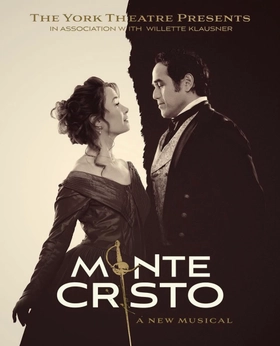
Wrongfully imprisoned on the eve of his wedding, a young sailor emerges years later as the wealthy and educated Count of Monte Cristo, bent on a meticulous quest for revenge and reunion with his lost love.
The marketing for Monte Cristo insists that it ought to be compared to an unspecified era of musicals gone by. It was a simpler time—a better time—when men could be men and women could be ornaments for men to fight over. The thing about older musicals is that you often have to kind of meet them where they’re at—there’s a case that it’s overly presentist to dismiss them outright for dated social attitudes and trope-heavy structure, and you might have to overlook the flaws to celebrate the things they do well and their historical influence on the art form. Even for the classics, though, this isn’t always an easy sell. Shooting for homage with a musical premiering in 2026 isn’t a charmless exercise, but it doesn’t likewise net any benefit of the doubt, even from an easy grader like me.
So it’s with a certain ambivalence that I admit that Monte Cristo does some things pretty well. From the jump, it’s immediately clear that they’ve invested a lot of time and money into this, given the pedigree of the cast, elaborate set, substantial costumes, and rich classical orchestration. Whether it has any commercial potential isn’t my business, but all the expense yields a lot of polish for a show in a 204-seat venue, and the old-timey pseudo-standards sound rather good coming out of all these prestigious mouths. That is to say that anything the material lacks in concrete musical import, it makes up for with, uh, Sierra Boggess’s dulcet tones. I am, I concede, humming a couple of tunes an hour after curtain.
The book and lyrical adaptation have speed bumps, some of which are the inevitable challenge of compressing a 1000-plus-page novel into a stage musical. In spite of a lot of expository dialogue, certain characters remain significantly underdeveloped, particularly Norm Lewis’s Villefort, whose arc is so reduced from the novel that he nearly feels like a cameo. Tony-winner Karen Ziemba doesn’t have a lot to do, either, playing someone’s wife. These things aren’t beyond repair—they just need to be ironed out by a director or dramaturg. The only one who feels too far gone is Sierra Boggess’s Mercedes, who doesn’t have a single character detail other than devotion to men. (She sings a ballad at one point asking when she lost herself—girl, I literally don’t know—when she’s introduced in Act 1, it’s all about how excited she is to marry Edmund.)
The text has other troubles that feel self-inflicted, especially when it veers into hackneyed political commentary. A song near the top tries to win us over early by decrying all the lying and cronyism of the era, which is true to the historical setting but feels like a wink. Later, a character extolls the virtue of an independent press as he uses his individual fortune to buy a newspaper and smear someone he doesn’t like. This contemporary gesturing feels out of place in an artistically (if not necessarily politically) conservative show, and it would be more compelling to own the off-trend ethos rather than struggling to be all things for all people. One moment suggests that a character is having a queer awakening and it elicits giggles from this Upper East Side audience.
Crowd reaction notwithstanding, I found Monte Cristo more fluffy and oldfangled than outright offensive. It’s pretty close to being a pretty proficient musical that happens to be pretty out of step with the zeitgeist. Act 1 needs a fair bit of cleanup, but Act 2 hits a stride when vengeful Adam Jacobs’s Edmund teams up with Danny Rutigliano’s best impression of a Wallace Shawn sidekick for some light swashbuckling and high-society subterfuge. As tempted as I am to get on a soapbox, and as much as this probably deserves it, listening to Sierra, Adam, Norm, and Karen sing palatable showtunes is not such a bad way to spend a Sunday afternoon. I know one or two people that I’m quite sure will detest it. :)