Giant
Music Box Theatre
New York, NY
New York, NY
What I'm seeing lately!
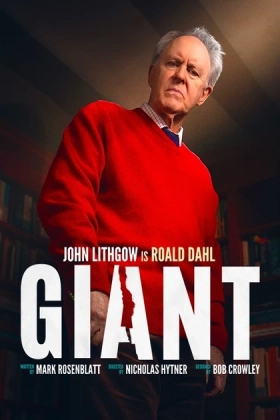
Roald Dahl, the world-famous children’s author, finds himself facing mounting outrage and moral scrutiny over his very public and unapologetic antisemitic remarks.
It’s hard to walk into this without a preconception of where it’s going to go, inasmuch as everyone comes in with the gist that “it’s the play about how Roald Dahl was an antisemite.” For those of us playing catch-up—as a Nebraskan, I knew more Dahl books than Jewish folks growing up—the program helpfully notes the story’s two verbatim tentpoles: Dahl’s controversial 1983 review of a book about the Israeli bombing of Beirut, and a later phone call with a journalist in which he explicitly doubled down on his viewpoints. With assumed knowledge in mind, Giant is not really written as an exposé but as a speculative character study about the incident, when executives from his English and American publishers descend on his home to try to coax him into doing damage control.
The theory at the heart of the thing is that the two sides of Dahl, beloved children’s author and raging antisemite, aren’t as hard to square away as they might seem. Playwright Mark Rosenblatt argues that there’s a unifying thread of viewing the world with juvenile simplicity—that Dahl’s inability to grasp nuance or engage adults with empathy was precisely what made his protagonists get up and walk off the page. He’s a great big kid. His emotional growth has been stunted by a lack of introspection, and, accordingly, he describes himself as a benevolent giant in the face of the dispositive evidence of his moral shortcomings. The staging hammers it home with a nearsighted foreshortening of Dahl’s estate that makes John Lithgow appear even larger than life, his Dahl existing in a world of foregrounds. The concept is sound, though I wonder if it isn’t too tidy of a summary equation for a play about how complex people can be.
A challenge for Rosenblatt is how to build dramatic tension for a clued-in audience. Dahl’s publishers can’t stop him from tarnishing his reputation, or we wouldn’t be here. The suspense has to come from the path we take, or, put another way, you’re waiting to hear what ghastly things he’s going to say and to whom. As luck would have it, we have a couple of bowling pins waiting for him to strike: both executives are Jewish, offering Dahl a ready-made opportunity to interpret their requests as personally motivated, and the stage is set. The arrival of the second, Jessie Stone—a younger, composite, American woman—kicks off much of the action, as Dahl can’t resist testing her, and Stone can’t resist pushing back.
Lithgow is as good as everyone says he is. I don’t know enough of his work to make sweeping proclamations about career-bests, but I can say with confidence that this is one of those intersections of actor and role where it’s hard to imagine anyone else doing it. He bears a striking resemblance to Dahl, height and all, which you ought to look up if you haven’t already. But, more than that, Lithgow, who has a reputation as one of his generation’s finest actors, has a remarkable ability to capture the character’s boyishness. His eyes glint with a juvenile intelligence deployed to impulsive, insensitive ends. When he’s challenged, his face turns beet-red with visceral reactivity. He’s totally loathsome.
What was more surprising to me, both for the lack of buzz and because the genre lends itself so naturally to one-man exhibition, is how much Aya Cash adds as the foil. I was really pleased to see her likewise net a Tony nomination. Stone’s counterpoint is telegraphed immediately by Cash’s diminutive stature and sensible day dress; opposite her towering, disheveled aggressor, she’s a veneer of cordial professionalism over a sensitive core, a benefit to her broader perspective that also creates a weakness to belligerence. Dahl will dig in and fight as long as it takes to win; Stone will put up steely resistance only until it’s apparent she won’t be heard.
The Israel-Lebanon conflict of the early ‘80s is rife with connections to the present-day genocidal occupation of Palestine, and I like the decision to bring this story to the Broadway stage in 2026. New York City has a distinct politics for its concentration of both center-left Jewish folks and the activist strain of the far left. For many of the latter persuasion, the insufficiency of the United States’ response to Israeli atrocity has been a red-line divorce from the mainstream Democratic party. But, at the same time, Dahl’s line of antisemitic oversimplification—that Jewishness necessarily implies support for the state of Israel as diasporic redress and, beyond that, blank-check approval of its regional dealings—is a misperception on the rise, including in the more dogmatic corners of modern leftism. The theater community, in particular, is notorious for uncompromising views; while the play is didactic, its subject matter and venue give it a puncher’s chance of showing someone they’ve gone too far.
It’s a commendable tack, but I wish that that didn’t result in such a rigid structure. The two Jewish characters are consistently, conspicuously arranged in various states of rhetorical opposition, functioning as a Zionism 101 lecture crossed with a demonstration that, Actually, Jewish People Can Reasonably Disagree About This, Too. You know, it’s a tricky balance to strike. You want to depict this man’s complex legacy, but you need to provide the historical context to illustrate why his story is so timely for the modern audience, and you feel a responsibility to show your work on why he’s wrong. In the end, it feels a bit mechanical—an A-then-B-implies-C dramaturgy that leaves little room for alternate interpretation.
Still, there are little moments of organic drama that reach for something greater. After an hour-plus of berating Jessie, Roald takes a sudden, genuine, empathetic interest in her special-needs son. One wonders, at what age will the boy cease to be an innocent, inheriting culpability for the actions of a sovereign state on the other side of the world? And can his mother, in good conscience, allow her son to have the art without the artist?