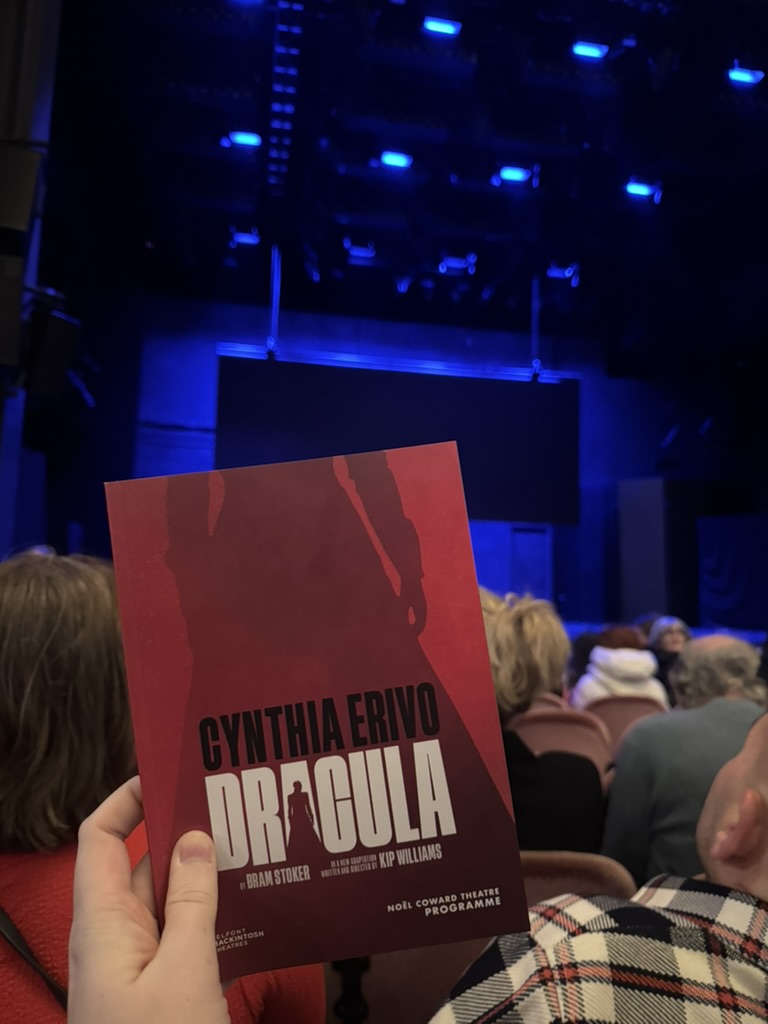
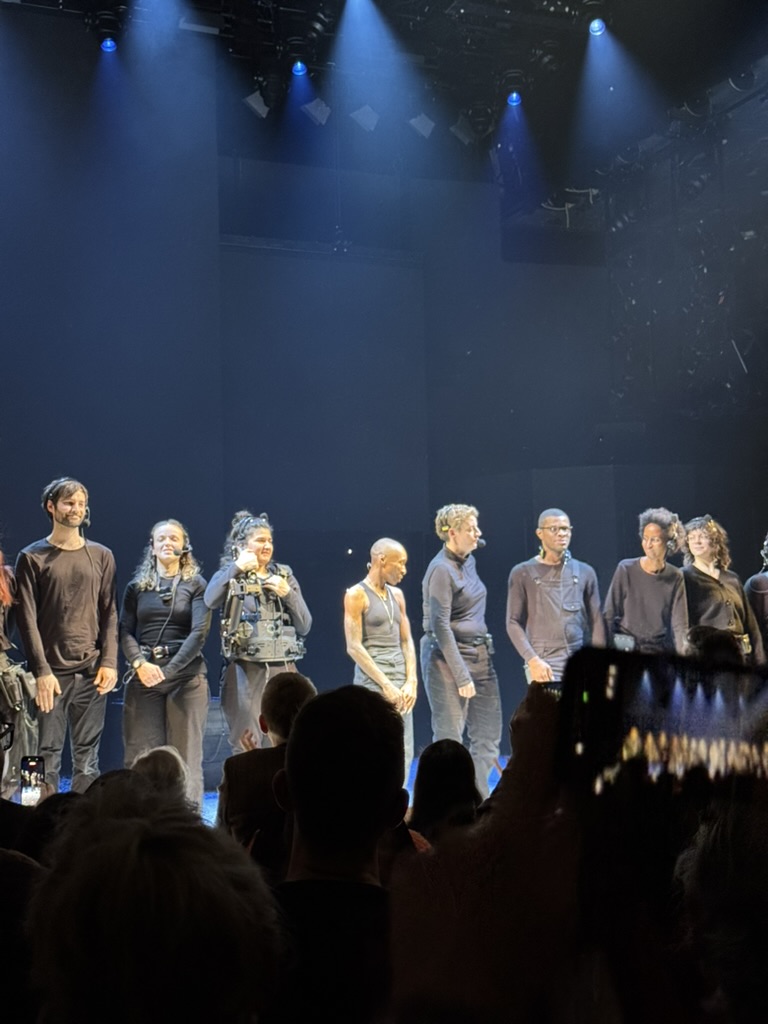
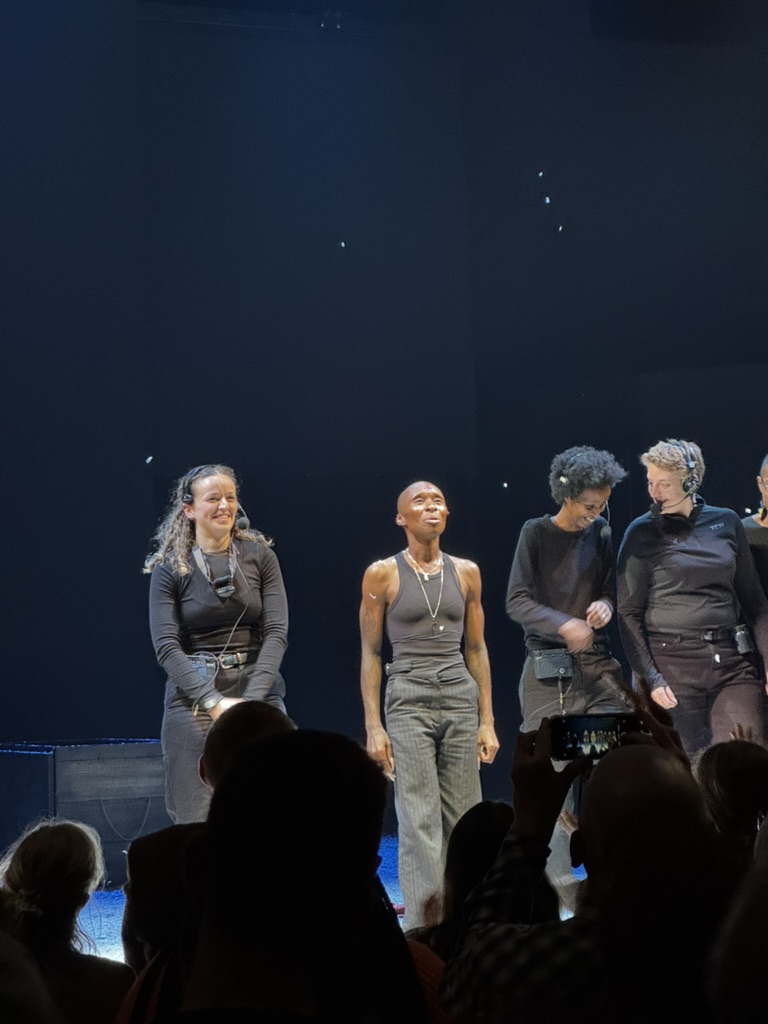
Dracula
Noël Coward Theatre
London, England
London, England
What I'm seeing lately!
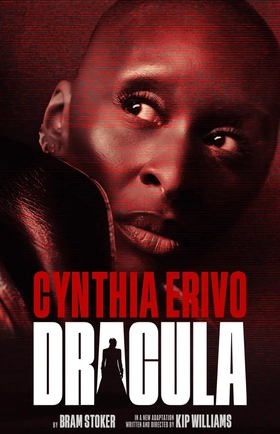
A radical “cine-theatre” reimagining of the gothic horror classic in which a single actor performs all 23 roles—interacting with pre-recorded video and live camera feeds—to retell the story of the vampire’s invasion of London.
I’m sorry to say that this was a mess. We didn’t plan to see the first preview, but circumstances conspired: three prior performances were cancelled to give star Cynthia Erivo extra time to rehearse. Some might call that a foreboding sign, but we walked in with a healthy amount of hype nonetheless. Cynthia is, after all, the it-performer of the moment, and I had really enjoyed Kip Williams’s previous writing/directorial effort, The Picture of Dorian Gray.
Dracula, its eagerly anticipated follow-up and spiritual successor, is a mostly verbatim but aggressively abridged adaptation of Bram Stoker’s novel, transplanting its epistolary structure to the stage. As in Dorian Gray, this is performed by one actor in a hybrid multimedia format; prerecorded performances are superimposed on a live video feed of the stage performance on a large screen. Real-life Cynthia serves as a floating narrator, swapping into various identities scene-by-scene as each character voices their first-hand account of the investigation and confrontation of the infamous vampire. The camerawork eschews the abstract compositions of Dorian Gray for horror film homage peppered with direct addresses to the fourth wall. Even as a squeamish non-fan of the genre, I recognized some touchpoints: Twilight Zone-esque narration, found footage in the vein of The Blair Witch Project, shaky handheld shots reminiscent of the work of Sam Raimi.
Look, 20,000 words is a lot to learn, regardless of your talent or accomplishments. (A lot a lot.) Consider the comparables. Elevator Repair Service’s Gatz ends with a 30-minute off-book recitation of The Great Gatsby’s final chapter, a widely celebrated feat of literary memorization amounting to some 5,000 words. Suzie Miller’s Prima Facie, an acclaimed, frenetically paced one-woman show from a couple of years ago, clocks in at about 17,000 words. Dorian Gray was longer, but at least that had the advantage of a consistent narrator perspective. It’s not just that the degree of difficulty of performing Dracula is high—it’s that, without exaggeration, this ranks among the very most demanding roles ever attempted on a major commercial stage. And Cynthia is hot off the press tour for Wicked: For Good and just wrapped production of a Prima Facie film—when exactly was she supposed to learn all this?
So it’s with some reluctance that I have to ding her for not having the text down pat. The production has made the practical decision to install teleprompters at strategic points around the theater—on the conductor monitors, in the stalls-level boxes, and off-stage left and right—and Cynthia is depending on them to a highly visible degree, her every glance magnified to a punishingly large scale on-screen. Combined with the fact that she’s totally out of breath, she spent most of the show in a stumbling, halting delivery that evoked the wrong form of sympathy. It was just plain hard to follow the story or even gather its emotional gist.
Meanwhile, the prompters themselves are a major distraction. An operator is toggling them manually to try to avoid disrupting the video feed; you can tell it’s being done by hand because they aren’t timed with the perspective, blocking, or overlay transitions, lingering in the frame for variable but lengthy seconds, strongly implying they were a late scramble. (I don’t believe they were present in the original Australian production or in Dorian Gray, but I’m not entirely confident in this.) If Cynthia needs them, she needs them, but it would be better to keep them on and call it “Brechtian” than sloppily try to hide a crutch. For the first few minutes of the show, I thought the bright flashes in boxes left and right were an usher’s flashlight guiding latecomers to their seats or busting a bootlegger. This was far from the only technical issue—there were lots of minor timing problems both in image composition and in line delivery—but I don’t want to dwell on these because this whole class of problems should be, at least theoretically, growing pains for a show in early previews. They are fixable, but Cynthia and Kip have a lot of work to do, and not a lot of time to do it. The show is on.
I’m happy to overlook some of these things—it’s a first preview of a complex show, after all!—but there are other, more worrying problems that I don’t see how they can fix. A disadvantage of retaining the novel’s structure is that it relegates the real Cynthia into the background of many scenes. Stoker’s narrators are often not at the center of the story and in some cases are tertiary non-participants entirely, most apparently when Cynthia takes on the role of Dr. Jack Seward. This is a fine device on the page, but terribly dull on stage. Several sequences, especially in the middle third of the show, amount to real Cynthia crouching off to the side and nodding along while four digital Cynthias have lengthy expository conversations or, worse, actually carry out some intense action. Real Cynthia never steps into the role of Abraham Van Helsing and only briefly appears as Dracula himself.
I would be remiss if I didn’t note that some of the imagery is genuinely pretty cool. A key feather in Kip’s “cine-theatre” cap is that it very easily facilitates an effect of the vampires neither appearing in mirrors nor casting shadows. (A minor, inconvenient detail is that the other, non-vampire characters also don’t cast shadows. I suggest you ignore this.) A climactic battle in the snow features Cynthia bouncing from voice to voice, infusing the scene with urgency and a swirling disorientation. Other scenes are a bit marred by some silly costuming—Cynthia, famously self-serious, distinct in appearance, of cultivated fashion sense, especially looks a fair bit silly in Van Helsing’s stark white long hair and full beard. Some sophisticated interactions between characters look like bad green-screening. Is it camp? Is she the right casting for camp?
The fundamental flaw with Dracula is that these decisions come at the expense of the story without a particularly good reason “why.” The raison d’être of Dorian Gray wasn’t its visual spectacle or the effectiveness of its storytelling; there, too, the single-actor gimmick compromised the intelligibility of the original text, but it was justified by an incisive critique of the superficial homogenization of society. Dracula doesn’t really have an equivalent thrust, which leaves it feeling like a Herculean stunt for the sake of creating some neat imagery. What’s wrong with a little spectacle? Nothing, really, but if that’s the reason we’re in the room, you had better be able to pull it off. Otherwise, you have nothing—and that’s not nitpicking, but meeting the show on its own terms. You decided to do the hard thing. I sincerely hope that they’re able to iron out the early-preview bumps, but I worry that the concept itself is flawed beyond repair.