Calf Scramble
Synopsis
Deep in a dusty, sweltering East Texas barn, five teenage girls raise calves for their Future Farmers of America projects and wrestle with what it means to be good—at school, at God, and at girlhood.
Mar 19, 2026, 2:00 PM
The immediate question is, of course, “How are they gonna stage a cow?” And it turns out the answer to that is the central conceit: five young women double as calves, which made me wince at first but proves unexpectedly thoughtful as the play unfolds. (It’s pretty giggleworthy to see, too. 😝)
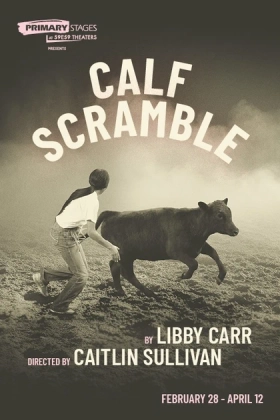
Calf Scramble is a coming-of-age play centered on an after-school Future Farmers of America program in east Texas. This is a distinct microregion characterized, in part, by the outsized physical, logistical, and cultural challenge of leaving it. We get to know a gaggle of 16-year-olds in a manner reminiscent of MCC Theater’s 2025 hit All Nighter, alternating between scenes exhibiting the wider group dynamic and quieter ones for pairwise relationships. Each girl is raising her own female calf, and the action builds towards a junior beef competition to see whose is largest, most docile, and best suited to be a mother, with significant prize money on the line. By having the actresses take turns doing their best bovine impression—mooing, chewing cud, getting roped—playwright Libby Carr develops a sociocultural critique of the way girls are pushed to be mothers before women, especially in this deeply conservative, fundamentalist part of the country. Many scenes, but most notably a disorienting climax in a storm, reinforce the association by asking the actresses to flip species on the fly. On the prospect of becoming pregnant, the most religious girl, Maren (played with delightful irritation by Maaike Laanstra-Corn), exclaims that she’d be “grateful to be chosen.”
The metaphor runs deeper than that. As Sofi (a deadpan Elisa Tarquinio), the de facto lead and audience surrogate, learns the ropes of calf-rearing, we see a tangible juxtaposition between how the girls treat each other and how they treat the animals. Give them the right feed mix, they say. Earn their trust with your touch. Trim the horns so they can’t hurt each other. As far as the cattle are concerned, the girls recognize that these are animals with needs that are straightforward, obligatory, or even a moral imperative to meet, and, ironically, this is more dignity than they seem to be able to extend to each other. The framing story of the calf competition explores the girls’ differing motivations for participating—financial, cultural, spiritual, and social—in order to illustrate that humans are more complex beings with varied needs. Our dealings with each other demand a layer of empathy, and its absence yields prejudice, and, consequently, shame—for bodily functions, sexual desire, religious backgrounds, or a simple preference to be here or there.
The play comes to feel a little overstretched when Carr extends the critique to scratch at the prison-industrial complex. The setting is Huntsville, TX, the headquarters of the Texas Department of Criminal Justice and a noted prison tourism hotspot for its five state prison facilities (plus two more just outside the city limits). There are, without a doubt, some relevant threads to tug on here: the power and potential for abuse in keeping another living being (human or bovine) in captivity, the relationship between shame and how we write the laws and enforce criminal justice, and the secondary costs of asking some humans to rob others of their bodily autonomy. I don’t think Carr does anything wrong in making these connections—far from it—it’s just that the conduit we take to get there is one girl having an off-stage parent who works at the prison, and it’s a huge topic to address secondarily in 90 minutes mostly spent with teen girls gossiping about each other. It could be better substantiated or otherwise trimmed.
I know Primary Stages is the resident company, but expensive productions don’t tend to play rent-a-stage venues like 59E59, so I was surprised and delighted to find that I liked director Caitlin Sullivan and scenic designer Cate McCrea’s staging quite a bit. It’s nicely tactile, with a mottled blue concrete wall on one side and metal gates lining the other to create a barnyard, with hanging tools, industrial lighting, and extension cords to complete the look. My favorite detail was the inclusion and use of big metal fans, which would be present in a barn to dissipate the heat and smell and gas; in an enclosed theater, they have an unusual, opposite, Smell-O-Vision effect, pushing the loamy smell of mulch into the audience.
Altogether, I would recommend this! More open stalls in the pen than it deserves. Rush tickets are super easy to get. Moo.