Blackout Songs
Synopsis
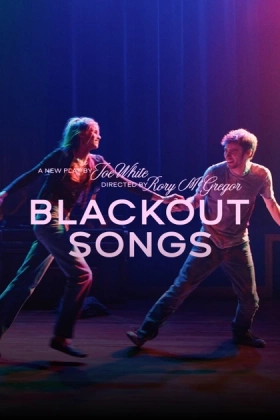
After a chance encounter at an AA meeting, “Him” and “Her” begin a blurry, co-dependent, and turbulent decade-long affair that blazes through ecstasy, relapse, and recovery.
Feb 28, 2026, 2:30 PM
Off-Broadway’s having a little moment with so-so plays about alcoholism. (An informal triptych: Blackout Songs in crisis, The Reservoir in detox, and The Dinosaurs in recovery.) For as much as I felt like Blackout Songs had some weaknesses, I do think that it gets something tonally very right in the subjective romanticism of the condition. When I get to my second or third hour at the bar, I don’t feel like a person with a medical condition or a spiritual deficiency. I feel like motherfucking Dorothy Parker or Serge Gainsbourg—a late-night city dweller in a smoky room nursing a cynicism-cum-mental-health-condition—never mind my glassy eyes or my slurry words or sour breath. My problem is literary, baby.
Leads “Him” and “Her” meet at an especially vulnerable moment when each is in the throes of addiction and neither is particularly ready to cut it out. They fall in something approximating love; we check in with their mutual enablement as they attend meetings, get hurt, steal communion wine, and drink the next few years away. The play is bookended by two conversations that I thought were particularly effective: one at the beginning about the blissful numbing afforded by a substance in the moment, and one near the end about it being your highest self and loving someone in the midst of that (or perhaps depending on it). The vast middle of the play is fragmentary by design, which works and it doesn’t—the time is disappearing and the memory is unreliable, but it leaves the characters feeling a bit too archetypal for my taste.
Most people who struggle this deeply have to find their bottoming-out point before they’re ready to make a change, if they ever do at all. Losing your partner this way is devastating, and it is also, for a certain unlucky few, a necessary shock to the system. The difficulty of portraying this on stage is that, for as intense as these feelings might be for the people experiencing them, from the external perspective it’s impossible not to view it through a lens of two addicts making bad choices, even in real life. It’s a love story between people who are hard to see except with certain logical detachment, and that’s only reinforced by not giving the characters names or backgrounds. We don’t get to know them, so we remain distant observers rather than confidants.